
Positive or negative, short- or long-term – how can the COVID-19 effect be assessed accurately?
maconda News January 2021
High double-digit revenue growth on the one hand, painful losses on the other. In some industries, COVID-19 has significantly fuelled demand, while in others it has come to a complete standstill. Who are the winners and losers, and why? How sustainable are the COVID-19 effects? And how can this be reliably determined within a Commercial Due Diligence? maconda shares its experience from recent months and provides insights into the particular challenges and analytical aspects that gain importance in times of COVID-19.
Looking purely at this fiscal year’s figures in relation to the previous year for the companies maconda worked with in 2020, the current winners and losers of the COVID-19 crisis can be identified quickly and easily. Highly attractive growth rates stand in stark contrast to sometimes severe declines. However, the picture painted by this purely numbers-based view is merely a snapshot. Rarely has attempting to draw conclusions about future business development from historical performance been as unsuitable as it is now – and such an approach quickly leads nowhere.
To comprehensively assess which industry is experiencing only a short-term boom or downturn and which is more long-term affected, the snapshot must be complemented by the dimension of the sustainability of the “COVID-19 effect.” Companies that appear promising at first glance lose their attractiveness, and vice versa. Quite frankly: identifying these differences is the core work of a professional Commercial Due Diligence provider. Nevertheless, one thing seems to hold true at present: rarely has careful strategic assessment in a company acquisition been as important as under the current uncertain circumstances.
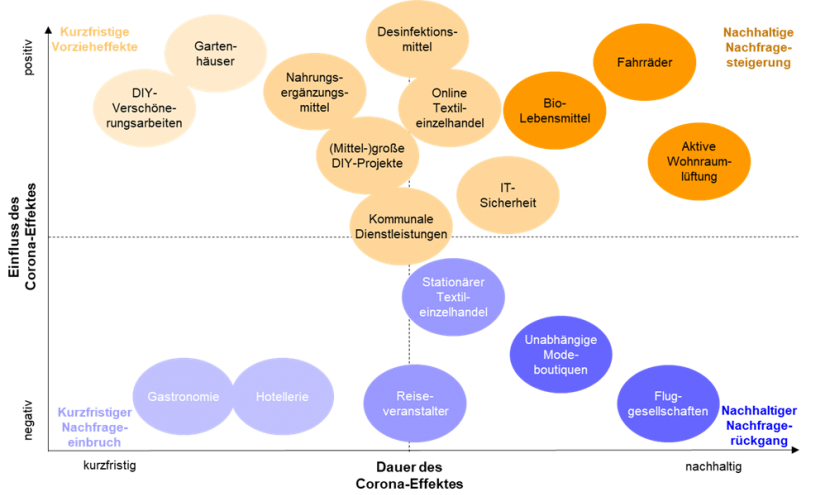
Impact of the COVID-19 effect on selected industries
Distinguishing short-term highs from long-term developments
In recent months, maconda has primarily dealt with COVID-19 winners. This is not entirely surprising, as external tailwinds are readily used for M&A processes – after all, they drive up KPIs and ultimately valuations. Equally unsurprising, however, is that such COVID-19 winners generally acknowledge the external effect (for the most part) but like to downplay its magnitude. Naturally, they attribute their growth not to COVID-19, and the performance gains achieved in 2020 are sustainable – of course.
Central to almost every assessment was the question: how much of the strong growth is attributable to the company itself and how much to COVID-19? And: how sustainable is the increase in revenue and margin?
Garden sheds and products for smaller home improvement projects (wall paint, wallpaper, furnishings) are, in our view, examples of rather short-term COVID-19 winners. Due to the increased time spent at home and in the garden, these segments saw a massive surge in demand. However, this is largely attributable to pull-forward effects: garden owners who bought a garden shed this year are unlikely to buy a new one – let alone a second one – in the next 15 years, and the number of properties with gardens remains constant. Renovation cycles for smaller home improvement projects in the private sector run at around six years. The high order volumes in 2020 mean that the corresponding demand will be missing in 2021 and subsequent years.
Bicycles and organic food, on the other hand, are among the sustainable COVID-19 winners. Admittedly, bicycles – particularly in the rapidly growing e-bike segment – also saw pull-forward effects. Primarily, however, existing fundamental market drivers were amplified in these industries. The avoidance of public transport and the increased number of domestic vacations accelerated the rediscovery of the bicycle as a serious alternative to the car, supported by the megatrends of environmental and health awareness. And anyone who has commuted to the office on their new e-bike, bypassing crowded trams, will not give this up entirely after COVID-19 – instead, they will buy a new, more expensive e-bike after three years and inspire others with their rides through the city.
And organic food? The already high demand for organic-quality food in retail and the shift in consumer behaviour toward sustainable nutrition were further accelerated by restaurant closures and increased home cooking. All of this will lead to growth rates above pre-COVID-19 levels in the medium term.
Particular challenges for the analysis:
- Uncertain future pandemic and business development, general uncertainty
- Performance during the COVID-19 crisis and current trading are not comparable / reliable / meaningful; no benchmark values
- Examining the true reasons for a decline in performance: COVID-19-related negative influences vs. difficulties that existed before COVID-19
- Obsolete business planning and uncertain forecasts
- Difficult direct comparison with peers, especially in niche industries with a thin or nonexistent current data base
- More hypothesis-driven and less data-driven work
- Practical uselessness of studies and surveys conducted before COVID-19, in a “linear world”
- Need for truly good interviews where the conversation partners do not merely recount what they have just read in the trade media – quality over quantity
- Restricted access to management due to more phone/video conferences instead of in-person meetings
The essential toolkit of a CDD advisor in times of COVID-19
The analytical challenges posed by COVID-19 are manifold, but they can be overcome.
So how does a CDD advisor deal with the many factors of uncertainty? The low reliability of current performance figures makes scenario calculations necessary – when validating the business plan and estimating the development of the relevant market. To normalise the COVID-19 effect, the optimal starting point for the projected future development should also be identified. Citing “major” studies in CDDs, as is often done? Honestly, that is no longer possible. Their relevance for forecasting is severely limited, in any case.
In many cases, however – especially in niche markets – purely data-driven analysis remains difficult, and hypotheses derived from broad market sounding become all the more important. Whether structured surveys of consumers and customers or exploratory discussions with industry insiders, associations, or competitors – interviews with various market participants then serve as the central source of information and an important basis for assessment.
Experience from recent months shows that some industries are benefiting from the crisis – and not just through a one-off surge. Sustainability can indeed be determined, even without the proverbial crystal ball. The analytical criteria are becoming stricter and perspectives more critical – among investors and financiers alike. The importance of the commercial assessment is growing, and a CDD is becoming necessary where perhaps none was required before COVID-19.
For more than 20 years, maconda has been supporting the acquisition, further development, and restructuring of companies. We also support our clients strategically and operationally in the digitalisation of their value creation, their products, their processes, and their entire business model – beyond isolated initiatives and buzzwords. We have completed over 800 consulting and implementation projects, including more than 450 transaction-related engagements. Our clients primarily include mid-sized companies as well as international private equity investors and family offices.
We are one of the most experienced Commercial Due Diligence advisors in the German-speaking region. This provides the foundation for assessments of opportunities and risks that are as rapid as they are precise – in CDD reviews as well as in (subsequent) value enhancement projects.
maconda focus industries: Consumer Goods | Food | Apparel & Textiles | Retail & eCommerce | Packaging | B2C Services | B2B Services (incl. Business Process Outsourcing) | Future Technologies & Software | Manufacturing Companies | Healthcare & MedTech